
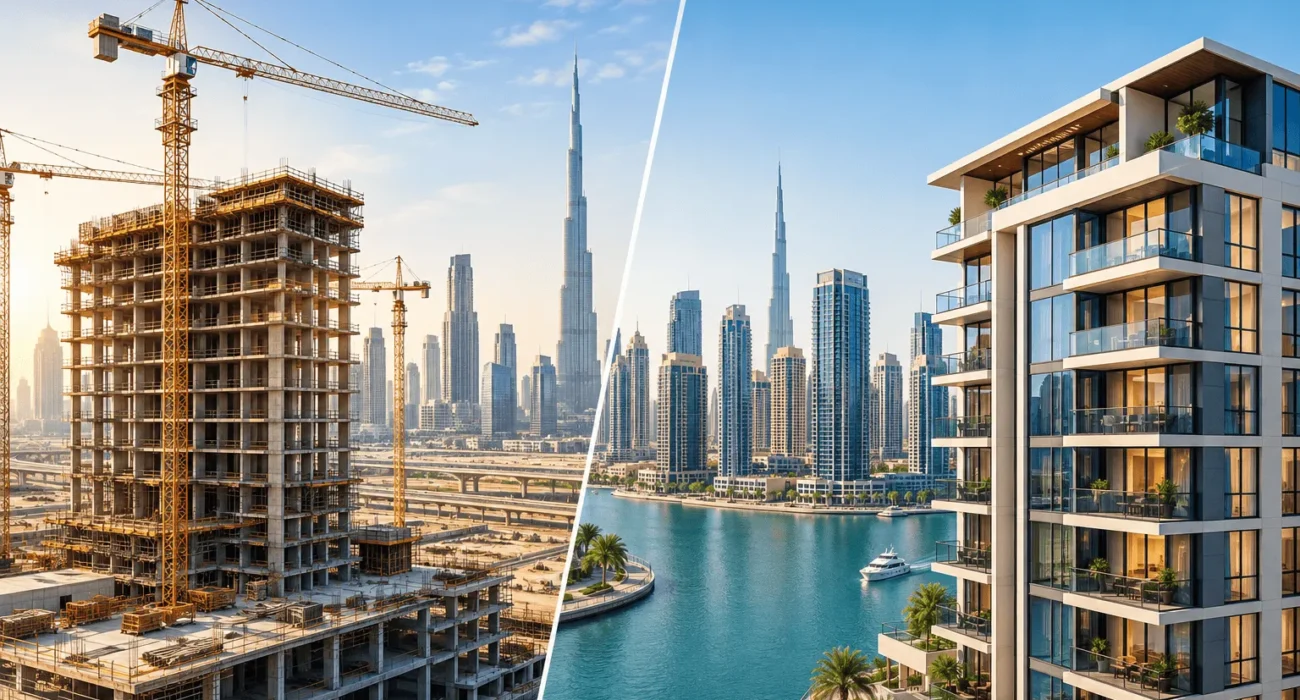
For anyone approaching real estate investment in 2026, the first strategic decision usually comes down to a single question: off-plan or ready? Both offer real returns. Both attract genuine buyer demand. But they play very different roles in a portfolio and the winning choice depends on the specific outcome you’re targeting, the time horizon you’re willing to hold, and how comfortable you are with execution risk. Here is a clear-eyed 2026 comparison of what each route actually delivers, backed by the latest market data, and how sophisticated investors are choosing between them.
The Dubai Market Backdrop in 2026
The two markets are behaving differently, and that’s the important starting point. Q1 2026 was one of the strongest quarters on record for Dubai real estate; overall total transactions surged 31% to AED 252 billion, with luxury transactions alone reaching 2,847 units worth AED 35.3 billion (+26% YoY).
Off plan continued to dominate Dubai’s residential market in Q1 2026, accounting for approximately 72% of residential transactions, while ready properties represented around 28%. , with average off-plan prices at AED 2,030 per sq ft in Q1 2026 (+12.22% YoY). Ready home transactions increased by 46.8% month-on-month in June 2026, marking the strongest monthly increase in three years, with average prices at AED 1,691 per sq ft (+5.62% YoY).
That combined picture tells the real story: both markets are strong, but they attract different buyer profiles for different reasons.
Off-Plan Property in Dubai: The Case for Capital Growth
Off-plan property investments in Dubai remain the market’s dominant category and for genuine reasons.
Lower entry pricing. Off-plan launches may offer competitive pricing and flexible payment structures compared with similar completed properties. However, pricing varies by project, developer and location. You’re securing tomorrow’s asset at today’s cost base.
Flexible payment plans. Common structures range from 20/30/50 to 40/60 to 60/40, sometimes with post-handover payment options. That structure lowers the upfront cash requirement dramatically compared with ready purchases.
Capital-growth leverage. Because appreciation accrues on the full property value while you have only deployed a fraction of the capital, off-plan magnifies returns during construction. Investors who bought Dubai off-plan in 2024–2025 have watched paper values climb through the build cycle.
A deeper, faster-moving inventory. With 75% of transactions in this category and constant new launches, off-plan gives you access to the broadest range of communities, unit types and developers.
The trade-offs are equally important. Construction delays may affect the expected handover date, while the completed property may differ slightly from initial renders or plans. Investors also cannot earn rental income until the property is completed and ready to lease. For these reasons, developer credibility, project registration, escrow protection and construction progress should be carefully reviewed before purchasing.
Best-suited profile: investors with a 3–5 year horizon focused on capital appreciation, comfortable with construction risk, and buying from developers with proven delivery records.
Ready Property Investment in Dubai: The Case for Immediate Yield
Ready property investment in Dubai is having its strongest moment in three years. Ready-property demand strengthened during 2026, showing that more investors are prioritising immediate income potential, greater visibility and lower construction-related risk , which is why there was a big increase in these kinds of sales in the first part of 2026. It seems like investors are thinking differently about what they want from their investments.
Immediate income. A completed property can potentially begin generating rental income once it is leased. A property that is already tenanted may provide income immediately after purchase. In Dubai’s current market, that means gross rental yields of 6.9% on apartments, 5.1% on townhouses and 4.5% on villas with citywide average yield at 6.58%.
No construction-completion risk. What you see is what you own. No timeline slippage, no render-to-reality gap.
Faster mortgage utilisation and resale liquidity. Ready properties may be easier to finance and resell, although this depends on the building, location, property condition and buyer demand. The resale market is deeper for completed units in established communities.
Proven asset performance. You can inspect the building, evaluate the community, check the service charges, and speak to existing residents before you commit. In a maturing market where due diligence matters more, that visibility is genuinely valuable.
The trade-off is straightforward: a higher upfront funding requirement and potentially more moderate price growth compared with selected off-plan projects. compared with off-plan launches. Ready property saw 5.62% price growth year-on-year versus off-plan’s 12.22% so the appreciation curve is real but less aggressive.
Best-suited profile: income-focused investors, buyers wanting lower execution risk, and those with a longer 5–10+ year holding horizon prioritising yield stability over capital-growth upside.
Side-by-Side: The 2026 Numbers
| Metric | Off-Plan Dubai | Ready Dubai |
|---|---|---|
| Q1 2026 avg price (per sq ft) | AED 2,030 | AED 1,691 |
| Q1 2026 price growth (YoY) | +12.22% | +5.62% |
| Share of transactions | ~75% | ~25% |
| Entry deposit | ~10–20% | ~25% (expat mortgages) |
| Payment structure | 20/30/50, 40/60, 60/40 plans | Full cash or mortgaged upfront |
| Rental income | On handover only | Immediate |
| Execution risk | Moderate | Minimal |
| Best for | Capital growth (3–5 years) | Income + long-term hold |
Which Strategy Actually Wins in 2026?
The honest answer is: it depends on what you’re optimising for. A 2026 investment case built purely on appreciation still favours off-plan in strong communities with proven developers; the capital-growth leverage remains hard to match. A case built on cash flow, execution certainty and lower risk favours ready property in established districts.
Some investors choose to include both off-plan and ready properties in their portfolios. The pattern is clear across the strongest Dubai real estate investment portfolios today
- Off-plan allocation in a design-led project from a reputable developer, chosen for capital growth to handover
- Ready allocation in an established community for immediate rental yield
That combination captures both sides of the cycle. Rental income from a ready property may help offset some portfolio expenses, while an off-plan property may provide longer-term growth potential.
Appreciation from the off-plan asset provides the growth engine. Together, they hedge against different market risks in ways neither strategy alone can.
What to Look For in Either Route
Whichever route you choose, the same principles apply.
The developer’s track record is decisive. In a maturing market, the top developers pull ahead. Verify RERA registration, escrow, delivery history and service-charge track record before committing.
Location fundamentals matter more than launch hype. Communities with infrastructure, schools, transit and long-term demand outperform speculative addresses regardless of off-plan vs ready.
Stress-test the numbers against a flat market. A UAE property investment case that only works in a rising market isn’t a case. Confirm the deal holds on yield or holding value alone.
Know your holding period. Off-plan resale may be restricted until a required percentage of the purchase price has been paid. Investors should therefore match the property and payment plan with their expected holding period.Match your strategy to your timeline honestly.
Frequently Asked Questions
Is off-plan or ready property a better investment in Dubai in 2026?
Both work but for different goals. Off-plan properties in Dubai can still be a good idea because they can increase in value more quickly. For example, off-plan properties went up in value by 12.22 percent over the year while ready properties only went up by 5.62 percent. Also, off-plan properties often have payment plans that make them easier to buy. Ready property investment delivers immediate rental yield (6.58% citywide average) and zero execution risk. Many investors hold both.
What returns can I expect from off-plan property in Dubai?
Returns from off-plan property vary considerably depending on the purchase price, location, developer, construction progress and market conditions. Capital appreciation is possible but is never guaranteed. In strong communities, with capital-growth returns on the full property value even though only a fraction of capital has been deployed.
Is ready property investment in Dubai still worth it?
Yes. Ready-home transactions rose 46.8% month-on-month in Q1 2026 the strongest ready-market quarter in three years with average prices of AED 1,691 per sq ft and rental yields of 6.9% for apartments and 4.5% for villas.
Should I invest in Dubai off-plan or ready as a first-time investor?
Ready property may suit first-time investors who want to inspect the property and potentially generate rental income sooner. Off-plan property may suit investors with a longer holding period who are comfortable with construction and handover risk. The right choice depends on budget, objectives and risk tolerance.
What are the dangers of investing in off-plan property?
The main risks include construction delays, changes between the original plans and the completed property, market fluctuations and developer-related issues. Buyers can reduce these risks by choosing a reputable developer, confirming the project’s RERA registration and escrow account, monitoring construction progress and reviewing all contractual terms carefully.
In Dubai, the choice between off-plan and ready property depends on the investor’s objectives, holding period, available capital and risk tolerance. Off-plan property may offer flexible payment plans and long-term growth potential, while ready property offers greater certainty and the possibility of earning rental income sooner. Neither option guarantees returns. Investors should choose the developer and location carefully, account for all ownership costs and seek independent professional advice before making a decision .
